
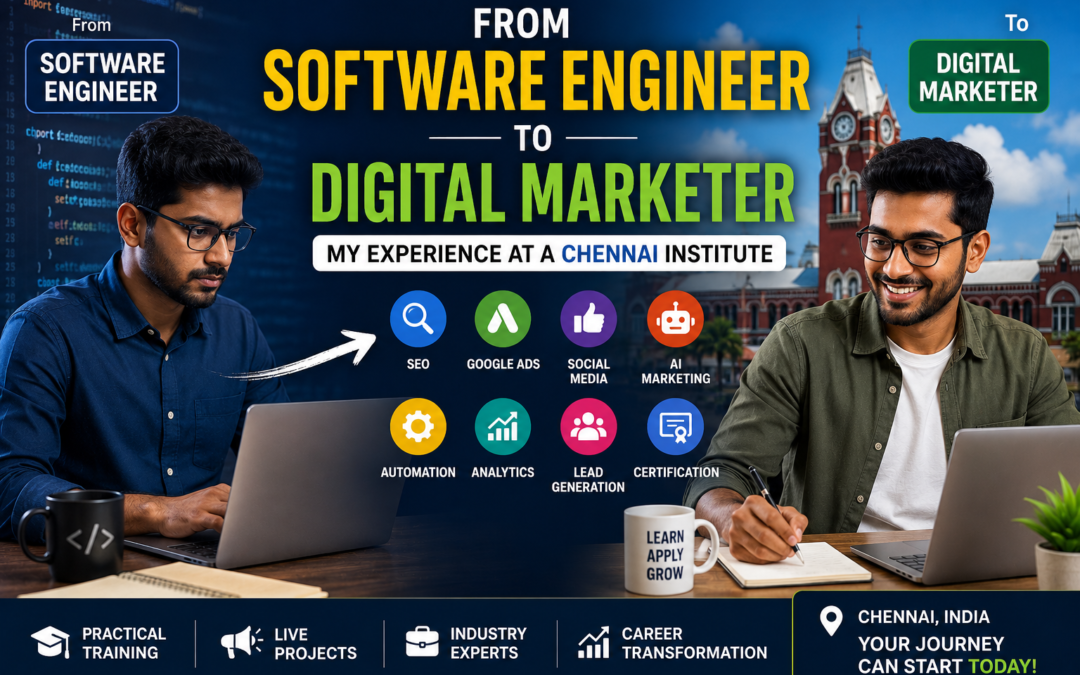
Discover how a software engineer transformed his career through a digital marketing course in Chennai and gained future-ready skills in AI and marketing.
Contents
- 0.1 Introduction
- 0.2 Why a Software Engineer Would Consider Digital Marketing
- 0.3 The Challenge of Starting Over
- 0.4 Why I Chose a Digital Marketing Course in Chennai
- 0.5 My First Few Weeks: A Complete Mindset Shift
- 0.6 Discovering the Business Side of the Internet
- 0.7 Google Ads Changed How I Think About Customer Acquisition
- 0.8 The AI Component Was a Game-Changer
- 0.9 Learning Automation Like a Systems Engineer
- 0.10 Social Media Was More Strategic Than I Expected
- 0.11 Building Real Skills Through Practical Projects
- 0.12 The Portfolio Became My Biggest Asset
- 0.13 Learning About Freelancing and Client Work
- 0.14 What This Career Shift Taught Me
- 0.15 Why Digital Scholar Played a Key Role
- 0.16 Conclusion
- 1 FAQs
- 1.0.1 1. Can a software engineer switch to digital marketing?
- 1.0.2 2. Is a digital marketing course in Chennai suitable for IT professionals?
- 1.0.3 3. What skills can software engineers learn through digital marketing?
- 1.0.4 4. Does digital marketing require coding knowledge?
- 1.0.5 5. How does AI help in digital marketing?
- 1.0.6 6. Can software engineers become freelance digital marketers?
- 1.0.7 7. Is SEO included in a digital marketing course in Chennai?
- 1.0.8 8. What makes a digital marketing course in Chennai valuable?
- 1.0.9 9. Can digital marketing improve career flexibility?
- 1.0.10 10. Why choose Digital Scholar for a digital marketing course in Chennai?
Introduction
This article is written by Hemanth jain-best social media marketer in chennai
For most of my career, my world revolved around code, systems, debugging, and deadlines. Like many software engineers, I believed my career path was already defined. Build technical expertise, move into senior roles, and continue climbing the corporate ladder.
But somewhere along the way, I realized I wanted something more.
I wanted to understand how businesses grow. I wanted to know what drives customer decisions.
I wanted to learn skills that combined creativity, strategy, technology, and business.
That’s when I started exploring digital marketing.
What began as curiosity eventually became one of the most important career decisions I’ve made. This is the story of how a digital marketing course in Chennai helped me transition my mindset from software engineer to digital marketer and completely changed how I view professional growth.
Why a Software Engineer Would Consider Digital Marketing
When people hear “software engineer,” they usually assume the person already has a stable and rewarding career. And that’s true.
But modern careers are no longer linear. Technology is evolving rapidly. Businesses are becoming increasingly digital.
AI is changing workflows across industries. As I observed these changes, I noticed something interesting. The professionals creating the most impact weren’t necessarily the ones with the strongest technical skills.
They were the people who understood:
- Customer behavior
- Business growth
- Digital platforms
- Marketing automation
- Data-driven decision making
I wanted to understand that side of the business. Digital marketing seemed like the perfect place to start.
The Challenge of Starting Over
The hardest part wasn’t enrolling. The hardest part was admitting I knew very little about marketing. As engineers, we’re comfortable with logic, systems, and structured thinking.
Marketing felt different. There were new concepts everywhere:
- SEO
- Content marketing
- Google Ads
- Meta Ads
- Funnels
- Lead generation
- Personal branding
Initially, it felt overwhelming. But what helped was realizing that digital marketing is actually far more data-driven than many people think. That realization made the transition easier.
Why I Chose a Digital Marketing Course in Chennai
When researching programs, I found that many courses focused only on traditional digital marketing topics. However, the industry itself had already evolved.
AI was becoming a major part of marketing workflows. Automation was becoming essential. Businesses were looking for marketers who could combine strategy with technology.
That’s why I was drawn toward a program that incorporated both digital marketing and AI-powered marketing systems. The curriculum aligned closely with where the industry was heading rather than where it had been.
My First Few Weeks: A Complete Mindset Shift
The first few weeks challenged many assumptions I had about marketing. I discovered that marketing isn’t simply about advertising products.
It’s about solving problems. It’s about understanding audiences. It’s about creating systems that generate growth. The training structure included:
- Live sessions
- Practical assignments
- Portfolio-building exercises
- Real-world implementation
- Capstone projects
As someone coming from a technical background, I appreciated the hands-on approach. Learning by doing made everything easier to understand.
Discovering the Business Side of the Internet
As a software engineer, I had spent years helping build digital products. But I rarely thought deeply about how those products actually acquired customers.
Digital marketing changed that. I started learning how businesses attract traffic through:
Search Engines
Understanding:
- Website optimization
- On-page SEO
- Off-page SEO
- Local SEO
- Video SEO
helped me see how users discover businesses online. Suddenly, websites weren’t just technical assets anymore. They became growth assets.
Google Ads Changed How I Think About Customer Acquisition
One of the biggest eye-openers was learning Google Ads. Previously, I viewed advertising as something companies simply spent money on. The training showed me that successful advertising is highly strategic. I learned about:
- Keyword research
- Search campaigns
- Display campaigns
- YouTube campaigns
- Performance Max campaigns
- Conversion tracking
- Campaign optimization
For someone who enjoys analytics and systems, this was fascinating. Every decision could be measured. Every campaign produced data. Every optimization had a purpose.
The AI Component Was a Game-Changer
Perhaps the most exciting aspect of the experience was the focus on AI. As an engineer, I was already interested in emerging technologies. Seeing AI applied to marketing opened an entirely new perspective. The training introduced concepts such as:
AI-Powered Content Creation
Using AI to assist with:
- Blog creation
- Ad copy
- Social media content
- Email campaigns
Prompt Engineering
Learning structured prompting techniques helped improve AI outputs significantly.
Generative AI Tools
Exposure to tools capable of generating:
- Text
- Images
- Videos
- Voice content
showed how marketing workflows are evolving. This wasn’t just marketing education. It felt like future-proofing my skill set.
Learning Automation Like a Systems Engineer
This was the point where my technical background became an advantage. The program introduced:
- AI agents
- Marketing automation
- Workflow creation
- Automated publishing systems
- Lead management processes
For the first time, I could see how engineering thinking and marketing strategy could work together. Automation wasn’t replacing marketers. It was making them more effective.
Social Media Was More Strategic Than I Expected
Before joining, I assumed social media marketing was mainly about posting content. I was wrong.
The training covered:
- Content systems
- Reels planning
- AI-generated scripts
- Content calendars
- Personal branding
- Profile optimization
- AI-powered outreach
- Authority building
YouTube
- Video strategy
- SEO optimization
- Audience retention
Everything was tied back to business outcomes. That strategic approach completely changed my perception of social media.
Building Real Skills Through Practical Projects
One of the reasons many career transitions fail is because people consume information without applying it. This course took the opposite approach. Students were expected to:
- Execute campaigns
- Build marketing assets
- Create reports
- Develop workflows
- Apply automation systems
Every assignment contributed toward practical experience. I appreciated this because it mirrored how technical skills are developed. You don’t learn programming by reading. You learn by building. The same principle applies to marketing.
The Portfolio Became My Biggest Asset
One of the most valuable outcomes was portfolio creation. Instead of finishing with only theoretical knowledge, I had examples of work that demonstrated capability.
That included:
- Campaign frameworks
- Marketing systems
- Automation workflows
- Reporting templates
- Strategic plans
The portfolio became tangible proof of learning.
Learning About Freelancing and Client Work
Another unexpected benefit was exposure to freelancing fundamentals. The training covered:
- Offer creation
- Proposal development
- Service pricing
- Client outreach
- Discovery calls
- Client onboarding
This expanded my thinking beyond traditional employment. I began to understand how digital marketing creates multiple career paths.
What This Career Shift Taught Me
Looking back, the most important lesson wasn’t marketing. It was adaptability. The world is changing quickly. Professionals who continuously learn new skills create more opportunities for themselves. This experience taught me:
Technical Skills Alone Aren’t Enough
Understanding growth, customers, and marketing creates additional value.
AI Will Impact Every Industry
Learning how to use AI effectively is becoming essential.
Career Paths Are Flexible
A software engineer can learn marketing. A marketer can learn automation. The future belongs to people who combine skills.
Practical Learning Wins
Projects, implementation, and real-world experience matter more than theory.
Why Digital Scholar Played a Key Role
My transition wouldn’t have been the same without a structured learning environment. Digital Scholar stood out because of its focus on:
- AI-powered marketing
- Agency-style learning
- Live projects
- Portfolio development
- Capstone implementation
- Placement assistance
- Freelancing support
The combination of marketing fundamentals and emerging technologies made the learning experience particularly valuable.
Conclusion
A few months ago, I was a software engineer looking for a new challenge. Today, I understand marketing, customer acquisition, AI-driven workflows, content strategy, advertising systems, and automation in ways I never expected.
The journey wasn’t about leaving technology behind. It was about expanding my capabilities. The experience showed me that digital marketing isn’t just a career option. It’s a powerful skill set that connects business, technology, creativity, and growth.
For software engineers considering a career transition, a digital marketing course in Chennai can be more than an educational program. It can become the starting point of an entirely new professional trajectory.
And if you’re looking for a learning environment that combines modern marketing with AI-driven execution, Digital Scholar is a strong place to begin.
FAQs
1. Can a software engineer switch to digital marketing?
Yes. A software engineer already possesses analytical and problem-solving skills that can be valuable in digital marketing.
2. Is a digital marketing course in Chennai suitable for IT professionals?
Yes. Many IT professionals enroll to learn growth, marketing, AI tools, and customer acquisition strategies.
3. What skills can software engineers learn through digital marketing?
SEO, Google Ads, Meta Ads, AI tools, automation workflows, content marketing, and analytics.
4. Does digital marketing require coding knowledge?
No. Most digital marketing roles do not require coding experience.
5. How does AI help in digital marketing?
AI can assist with content creation, automation, campaign optimization, reporting, and workflow management.
6. Can software engineers become freelance digital marketers?
Yes. Digital marketing skills can create opportunities for freelance consulting and client services.
7. Is SEO included in a digital marketing course in Chennai?
Yes. SEO typically covers website optimization, on-page SEO, off-page SEO, local SEO, and video SEO.
8. What makes a digital marketing course in Chennai valuable?
Practical projects, AI integration, portfolio development, and real-world application make a course valuable.
9. Can digital marketing improve career flexibility?
Yes. Digital marketing skills apply across industries and support multiple career paths.
10. Why choose Digital Scholar for a digital marketing course in Chennai?
Digital Scholar offers AI-focused training, practical projects, agency-style learning, portfolio development, certifications, and career support.