
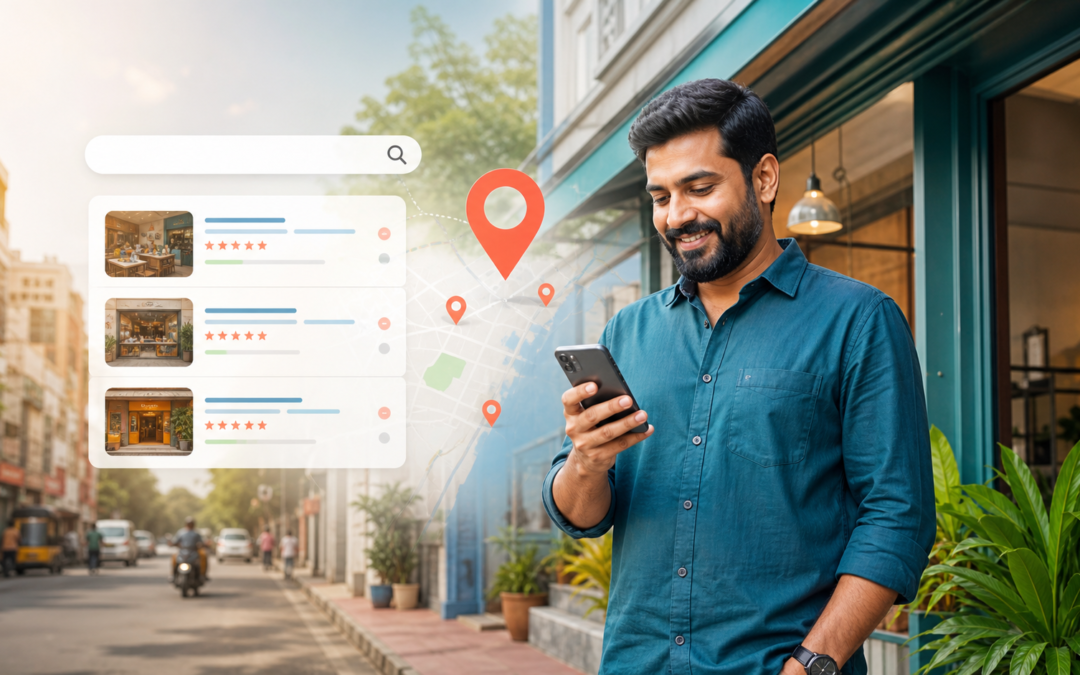
When someone in Chennai needs a dentist, interior designer, restaurant, repair service or nearby shop, the search often begins on Google. The person may type “near me,†add the name of an area, or simply search for the service and let Google use their location.
For a small business, appearing in those local results can bring calls, direction requests, enquiries and store visits. That is the purpose of local SEO.
Local SEO is not about adding “Chennai†to every sentence on your website. It is the process of making your business information clear, trustworthy and useful across Google Search, Google Maps, your website and other relevant platforms. It also involves building a strong local reputation through genuine reviews, useful content and consistent business details.
In this guide, I will explain how local SEO for small businesses in Chennai works, what to optimise first, which mistakes to avoid and how to measure whether your efforts are producing real business results.
Contents
- 1 What Is Local SEO?
- 2 Why Local SEO Matters for Chennai Businesses
- 3 Start With Your Google Business Profile
- 4 Build a Review System That Follows the Rules
- 5 Optimise Your Website for Local Search
- 6 Keep Business Information Consistent
- 7 Create Content With Local Value
- 8 Earn Relevant Local Links and Mentions
- 9 Add Local Business Structured Data
- 10 Create Separate Strategies for Multiple Locations
- 11 Measure Results That Matter
- 12 Common Local SEO Mistakes
- 13 A 30-Day Local SEO Action Plan
- 14 Conclusion
- 15 Frequently Asked Questions
- 15.1 How long does local SEO take to work?
- 15.2 Do I need a website if I have a Google Business Profile?
- 15.3 Can a home-based business use Google Business Profile?
- 15.4 How many Google reviews do I need?
- 15.5 Should I create a page for every Chennai neighbourhood?
- 15.6 What are the most important local ranking factors?
What Is Local SEO?
Local search engine optimisation helps a business become more visible when people search for products or services in a particular area. It is especially useful for businesses that serve customers at a physical location or travel to customers within a defined service area.
Examples include:
- Clinics and healthcare practices.
- Restaurants, cafés and bakeries.
- Salons and fitness centres.
- Home repair and maintenance services.
- Training institutes and consultants.
- Retail shops and showrooms.
- Professional services with a local office.
Local SEO can influence your visibility in regular organic results and in the map-based local results that often appear for location-sensitive searches.
Google explains that local rankings are mainly based on relevance, distance and prominence. Relevance is how closely a business matches the search. Distance considers how far the business is from the searcher or specified location. Prominence reflects how well-known and trusted the business appears to be. You can read Google’s explanation in its local ranking guidance.
You cannot control the searcher’s location, but you can improve how clearly Google understands your business and how confidently customers can choose it.
Why Local SEO Matters for Chennai Businesses
Chennai is not one single local market. Customer behaviour can differ across Anna Nagar, Adyar, T. Nagar, Velachery, Porur, OMR, Tambaram and other areas. Travel time also matters. A person may prefer a suitable provider nearby instead of a better-known business on the other side of the city.
Local SEO helps you compete at that decision point.
It Reaches People With Immediate Intent
A person searching for “AC repair in Velachery†is usually closer to taking action than someone casually reading about air conditioners. Local searches often have a clear need, service and location.
It Gives Small Businesses a Fairer Opportunity
You may not outrank a national brand for a broad term, but you can become highly relevant for a specific service in the neighbourhoods you genuinely serve. Accurate information, useful pages, strong reviews and local authority can make a small business competitive.
It Builds Trust Before the First Conversation
Customers may see your photos, opening hours, reviews, address, services and website before contacting you. A complete and consistent presence reduces uncertainty.
It Supports Both Online and Offline Sales
Local SEO can generate phone calls and website enquiries, but it can also influence visits, bookings, appointments and directions. That makes it valuable for businesses whose final transaction happens offline.
Start With Your Google Business Profile
A Google Business Profile is one of the most important local SEO assets. Google says a verified profile can help eligible storefront and service-area businesses manage how they appear in Search and Maps at no charge.
Verify and Secure the Profile
Claim the correct listing and complete the available verification process. Use a business-owned Google account and add trusted managers individually. Do not share one password across employees or agencies.
Keep ownership details updated when staff or partners change. Losing access to the profile can create a serious operational problem.
Use Your Real Business Name
Enter the business name as it appears in the real world. Do not add a list of keywords, areas or offers to the name unless they are genuinely part of the registered and displayed brand.
Google’s business representation guidelines require businesses to represent themselves accurately. Keyword stuffing in the business name can mislead customers and risk profile action.
Choose Accurate Categories
Your primary category should describe the main purpose of the business. Add a small number of relevant secondary categories only when they represent important services.
Think of a category as completing the sentence, “This business is a…†A dental clinic is a dental clinic; it is not every service mentioned on its website.
Complete Every Relevant Field
Add and regularly review:
- Address or service area.
- Phone number.
- Website URL.
- Opening and holiday hours.
- Business description.
- Services or products.
- Appointment or booking links.
- Accessibility and other available attributes.
Google states that complete and accurate information makes a business more likely to appear for relevant local searches. It also helps customers understand what you offer and when they can reach you.
Add Useful, Genuine Photos
Upload clear photos of the storefront, entrance, interior, team, products and completed work where appropriate. The objective is not to create a perfect catalogue. It is to help a customer recognise the business and know what to expect.
Update photos when the location, branding or services change. Avoid stock images that could belong to any business.
Build a Review System That Follows the Rules
Reviews influence trust and can support local prominence. They also reveal what customers value and where the experience needs improvement.
Ask at the Right Moment
Request a review after a completed service, successful delivery or positive customer interaction. Make the process easy with the profile’s review link or QR code.
Do not ask only customers you believe will leave five stars while deliberately filtering everyone else. Build a consistent process for genuine customers.
Never Buy or Incentivise Reviews
Do not offer discounts, gifts or payment in exchange for positive reviews. Google’s review guidance says reviews should reflect genuine experiences and prohibits incentives for posting, changing or removing reviews.
Purchased reviews can damage trust and may be removed. A natural review profile is more valuable than a sudden group of generic five-star comments.
Reply Like a Real Business
Respond to positive and negative feedback calmly. Thank the customer, address specific points and move sensitive conversations to a private channel.
Do not reveal personal information or argue publicly. A thoughtful response is written not only for the reviewer but also for future customers reading the exchange.
Learn From Review Language
Customers often describe services in simple language that differs from internal business terminology. Their words can help you improve service pages, FAQs and ad copy, provided you use the language naturally.
Optimise Your Website for Local Search
Your Business Profile and website should support each other. The website gives you more space to explain your services, expertise, locations and proof.
Create a Clear Contact and Location Page
Include your correct business name, address, phone number, hours and contact options. Add directions, nearby landmarks, parking or public transport information when useful.
For a service-area business, clearly explain the areas served without publishing a private home address if customers are not received there.
Build Useful Service Pages
Create a dedicated page for each important service when there is enough unique information to help the customer. Explain:
- What the service includes.
- Who it is suitable for.
- Your process.
- Expected timelines.
- Common questions.
- Proof, examples or testimonials.
- The next action to take.
Avoid producing dozens of thin pages that simply replace one Chennai neighbourhood name with another. Each page should exist because it answers a real customer need.
Use Location Terms Naturally
Include Chennai and relevant areas in the title, main heading, introductory copy or contact information where they accurately describe the page. Do not repeat them unnaturally.
A readable sentence for a customer is more useful than a paragraph written for a search engine.
Improve Page Titles and Meta Descriptions
Every key page should have a specific title describing the service and location. The meta description should summarise the value of the page and encourage the right searcher to click.
Avoid using the same title and description across every page. Duplicated metadata makes it harder to understand which page serves which intent.
Make the Website Mobile Friendly
Many local searches happen on mobile devices. Your pages should load quickly, present readable text and make the main action easy.
Test phone links, forms, map links and booking buttons. A high ranking is wasted if the customer cannot complete an enquiry.
Keep Business Information Consistent
Search engines and customers may find your business details on your website, Business Profile, social platforms, directories and industry sites. Major inconsistencies can create confusion.
Use the same core business name, address and phone number wherever possible. Minor formatting differences are less important than genuinely conflicting information.
Audit old addresses, disconnected phone numbers, duplicate profiles and outdated opening hours. Focus first on platforms customers actually use and trusted directories relevant to the business.
Do not submit the business to hundreds of low-quality directories. A few accurate and credible listings are more useful than a large amount of spam.
Create Content With Local Value
Local content should help people make decisions, not exist only to repeat place names.
Useful content ideas include:
- A guide to choosing the right service provider in Chennai.
- Pricing factors for a service in the local market.
- Seasonal maintenance advice based on Chennai weather.
- A case study from a local project, with permission.
- Answers to questions customers ask before visiting.
- Neighbourhood-specific delivery or service information.
- Coverage of a genuine community event or partnership.
For example, an interior designer could explain renovation planning for Chennai apartments. A clinic could publish clear preparation and after-care guides. A restaurant could explain catering options for local events.
The content should demonstrate experience and answer a useful question. Local keywords should follow naturally from the topic.
Earn Relevant Local Links and Mentions
Links can support prominence, but quality matters.
Possible sources include:
- Local business associations.
- Suppliers and professional partners.
- Industry directories with editorial standards.
- Local news coverage.
- Event sponsorships and community organisations.
- Universities, training partners or recognised institutions.
- Genuine collaborations with complementary businesses.
Ask whether the mention would still be valuable if search engines did not exist. If the answer is yes, it is more likely to be a sensible opportunity.
Avoid paying for large batches of unrelated links. Short-term manipulation can create long-term risk.
Add Local Business Structured Data
Structured data is machine-readable information that can help search engines understand the business represented on a page. Google provides documentation for LocalBusiness structured data, including properties such as business type, address, hours and contact details.
Use the most accurate business type and ensure the structured information matches the visible page. Validate it with Google’s Rich Results Test.
Structured data does not guarantee a special search result or better ranking. It supports clarity; it does not replace useful content or a complete Business Profile.
Create Separate Strategies for Multiple Locations
If your business has genuine offices or stores in different areas, create a useful page for each location. Include unique information such as:
- Correct address and contact details.
- Location-specific hours.
- Services available there.
- Staff or facilities.
- Directions and landmarks.
- Original photos.
- Relevant reviews or case studies.
Do not create fake locations, virtual offices or pages for areas where the business has no meaningful presence. Google Business Profile eligibility and representation rules should guide the setup.
Measure Results That Matter
Local SEO should be connected to business outcomes.
Track indicators such as:
- Calls from the Business Profile and website.
- Direction requests.
- Appointment or form submissions.
- Website visits from organic search.
- Visibility for relevant service-and-location queries.
- Review volume and response rate.
- Leads and revenue attributed to local search.
Google Business Profile performance data, Google Search Console, analytics and call or CRM data can provide different parts of the picture.
Do not judge progress only by one keyword from one device. Local results change based on location and context. Look for improvement across a group of relevant searches and, most importantly, enquiries from suitable customers.
Common Local SEO Mistakes
Creating Duplicate Business Profiles
Google generally recommends one profile per eligible business location. Duplicates can divide signals and create customer confusion.
Adding Keywords to the Business Name
An artificial name may create temporary visibility but violates accurate representation requirements and can place the listing at risk.
Publishing Thin Area Pages
Pages that repeat the same text for every neighbourhood offer little value. Build location pages only where the information is genuinely different and useful.
Ignoring Negative Reviews
A professional reply can show accountability. Silence or aggressive replies may discourage future customers.
Using the Wrong Phone Number or Hours
Basic errors cause immediate customer frustration. Review details during holidays, relocations and operational changes.
Expecting Instant Results
Local SEO develops through accurate information, customer experience, content and authority. Some improvements appear quickly, while competitive growth takes time.
A 30-Day Local SEO Action Plan
Week 1: Correct the Foundation
- Claim and verify the correct Business Profile.
- Check the business name, category, address, phone and hours.
- Remove or report genuine duplicate listings.
- Review website contact information.
Week 2: Improve the Customer Experience
- Add current photos and services.
- Test website forms and phone links.
- Improve the main service and contact pages.
- Create a simple review-request process.
Week 3: Strengthen Relevance
- Optimise page titles and headings.
- Answer important local customer questions.
- Publish one genuinely useful local guide.
- Check major directory and social profile details.
Week 4: Measure and Plan
- Record baseline visibility, calls and enquiries.
- Review Search Console queries.
- Identify one local partnership or mention opportunity.
- Plan the next two helpful content pieces.
Repeat the audit each quarter and whenever business details change.
Conclusion
Local SEO for small businesses in Chennai starts with accuracy and customer usefulness. Complete your Google Business Profile, maintain consistent details, build strong service pages, earn genuine reviews and publish content that solves local problems.
Do not chase shortcuts such as fake locations, purchased reviews or keyword-stuffed business names. They create risk without building a durable reputation.
The strongest local presence reflects the real business: where it operates, what it does well and why customers trust it. When those signals are clear across Google, your website and the wider local community, search visibility has a much stronger foundation.
Once people find you, a permission-based follow-up channel can help turn interest into repeat business. My guide to email marketing for small businesses explains how to build that system.
Frequently Asked Questions
How long does local SEO take to work?
Some changes, such as corrected hours or an improved profile, can appear relatively quickly. Meaningful ranking and enquiry growth may take several months, depending on competition, location, website quality and existing reputation.
Do I need a website if I have a Google Business Profile?
A profile can generate visibility, but a website gives you control over detailed service information, landing pages, proof, analytics and conversions. The two assets work best together.
Can a home-based business use Google Business Profile?
An eligible service-area business can hide its residential address when it travels to customers and does not serve them at that address. Follow Google’s eligibility and service-area rules carefully.
How many Google reviews do I need?
There is no universal number. Aim for a steady flow of genuine customer reviews and professional responses. Compare naturally with reputable competitors, but never buy or incentivise reviews.
Should I create a page for every Chennai neighbourhood?
Only when each page offers unique, useful information and the business genuinely serves that area. Near-identical pages with swapped place names can create a poor user experience.
What are the most important local ranking factors?
Google describes relevance, distance and prominence as the main local factors. Complete information, genuine reviews, a useful website, accurate categories and credible local mentions can support relevance and prominence.